
Table of Contents
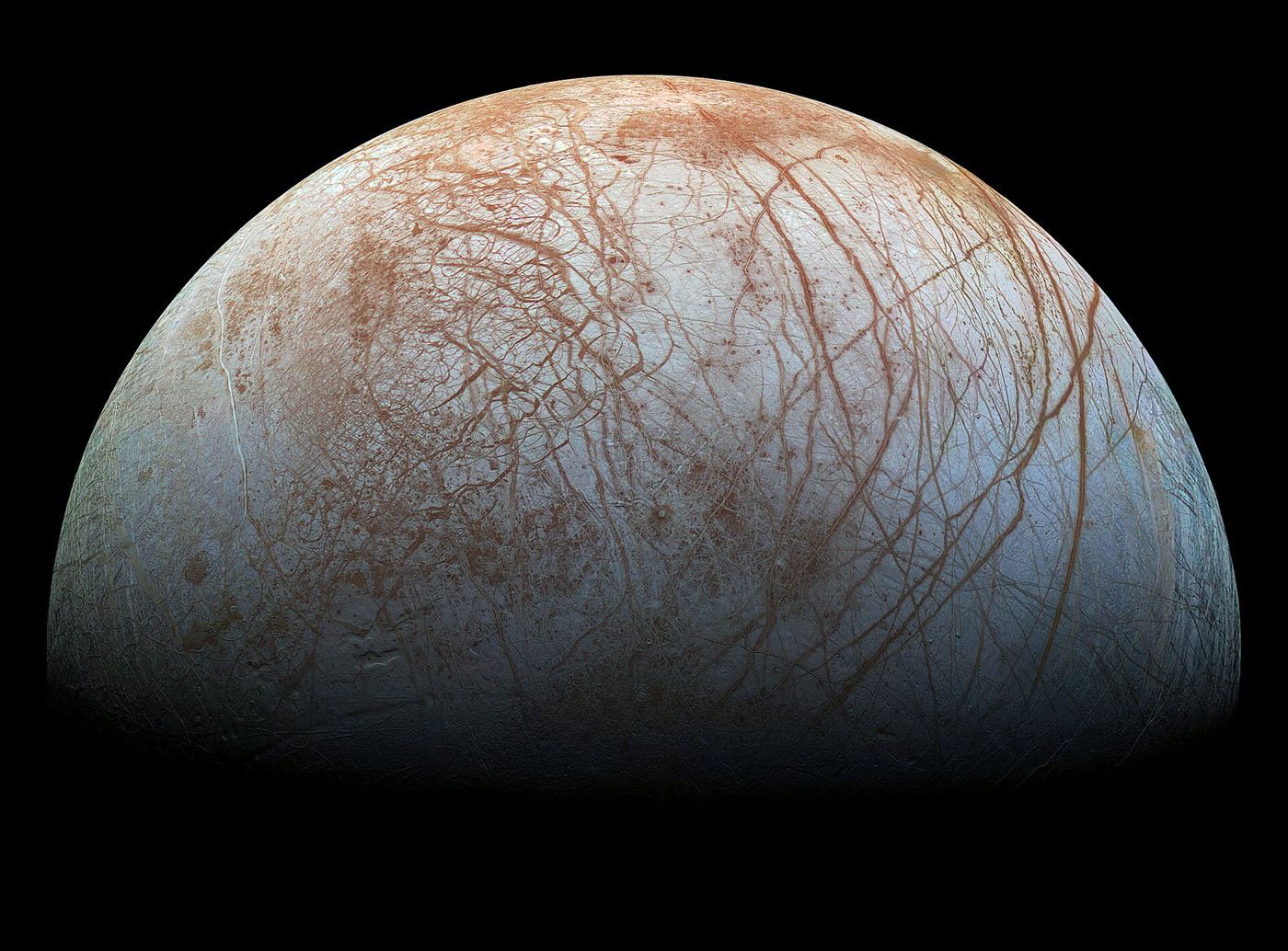
Jupiter’s moon Europa may hide pockets of salty liquid water much closer to its icy surface than scientists previously assumed, according to new modelling of its fractured crust. Europa is known to carry a deep global ocean beneath ice many kilometres thick, kept liquid by tidal flexing as the moon orbits Jupiter. The new work suggests that meltwater can also collect in shallow lenses within the shell itself, where cracks and chaotic terrain disrupt the ice. Such pockets would be far easier for a future lander or penetrating probe to reach than the deep ocean. Radar sounding from an orbiting spacecraft could detect the bright reflections these briny reservoirs produce. If confirmed, the pockets would offer sheltered environments where chemistry from the surface and the ocean might mix. Oxidants created by radiation on the surface could, over time, work their way down into the liquid, supplying energy that simple life could potentially use. Researchers emphasise that no life has been detected, only a more accessible place to look. The findings sharpen the questions mission planners want upcoming Europa observations to answer.
What the Evidence Shows
Interest in Europa’s shallow brine pockets has grown because similar double-ridge features on the moon closely resemble structures seen in Greenland’s ice sheet. In Greenland, radar has shown water refreezing above pockets and cracking the surface upward, a process that could explain Europa’s paired ridges without invoking the deep ocean directly. Laboratory experiments with salty ice support the idea, showing how brine stays liquid at temperatures where pure water would freeze solid. Mission scientists say combining radar, thermal mapping and magnetic measurements will be essential, because each instrument reveals a different property of the hidden ice. A shallow pocket that is actively refreezing should look different from one that formed long ago and has since gone quiet. Sampling even a small amount of material pushed up from such a pocket could reveal salts and organics carried from below. Engineers are studying drills and melt probes, but any future sampling must avoid contaminating a pristine ocean world. For now, the shallow-water hypothesis gives researchers a testable target and a reason to map Europa’s shell in far greater detail. Reporting and analysis from sources such as NASA track the same developments, and specialists following Europa’s shallow brine pockets say the direction is now consistent across independent lines of evidence.
The Wider Context
Funding bodies are watching Europa’s shallow brine pockets closely because the work sits at the junction of basic curiosity and practical return. Grant panels increasingly ask for a path from discovery to application, while researchers push back that the most valuable uses of fundamental science are rarely the ones written into the original proposal. The tension is productive when both sides stay honest about timescales.
What Happens Next
The long view on Europa’s shallow brine pockets is that fields advance by accumulation rather than by single announcements. This result adds a solid, checkable piece to a structure many teams are building, and its authors have shared their data so the piece can be tested from every side. That is how the picture eventually becomes reliable enough to act on. You can follow related developments in our coverage of science.

It is also worth remembering how quickly the picture in this area has changed before. Positions that looked settled a few years ago have been revised as new data arrived, and the same humility is appropriate now. The strongest coverage of this subject, and the most useful advice, tends to come from sources that update their views openly when the facts move, rather than defending an earlier position long after it has stopped fitting the evidence available.
